Object Status:
Extant
Accession Date:
By 1799
Primary Source Reference:
Charles Willson Peale, Lecture on Natural History 26. (ca. 1799). Academy of Natural Sciences of Drexel University Archives, coll. 40. / https://ansp.org/research/library/archives/0000-0099/coll0040/
Additional Source Text:
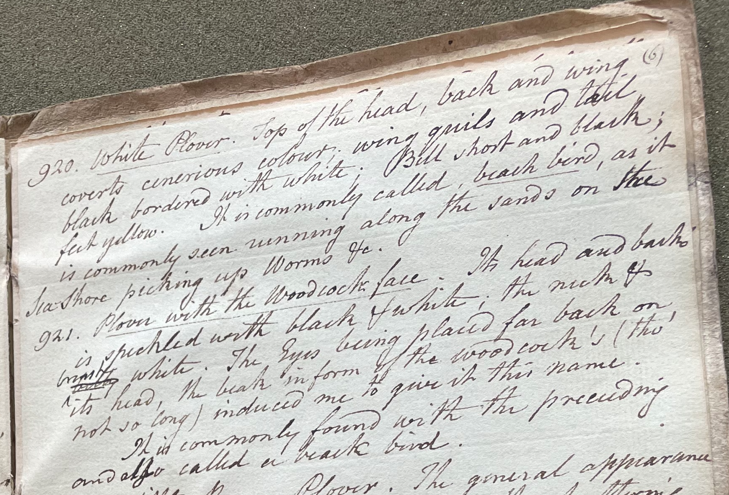
Charles Willson Peale (1741-1827) wrote, in his 26th Lecture (ca. 1799): "920. White Plover. Top of the head, back and wing coverts cenerious colour; wing quils and tail, black bordered with white; bill short and black; feet yellow. It is commonly called beach bird, as it is commonly seen running along the sands on the seashore picking up worms, &c. 921. Plover with the Woodcock face. Its head and back is speckled with black & white; the neck & breast white. The Eyes being placed far back on its head, the beak in form of the Woodcock's (tho' not so long) induced me to give it this name." (Academy of Natural Sciences of Drexel University Archives, coll. 40)
Peale mentioned, in "A Walk Through the Philad[elphi]a Museum" (1805–1806), "The White Plover with the wood-cock face", although what exactly he meant by this reference, or if he was referring to the same "White Plover" from his lecture, is not known. (Historical Society of Pennsylvania, coll. 0481)
Alexander Wilson (1766-1813) described this species under the name "Ringed Plover / Charadrius hiaticula" in American Ornithology vol. 5 (Pl. 37), where "Peale's Museum, No. 4150" was cited (Wilson 1812: 30). / https://www.biodiversitylibrary.org/item/175520#page/36/mode/1up (text) / https://www.biodiversitylibrary.org/item/175520#page/8/mode/1up (plate)
Notes:
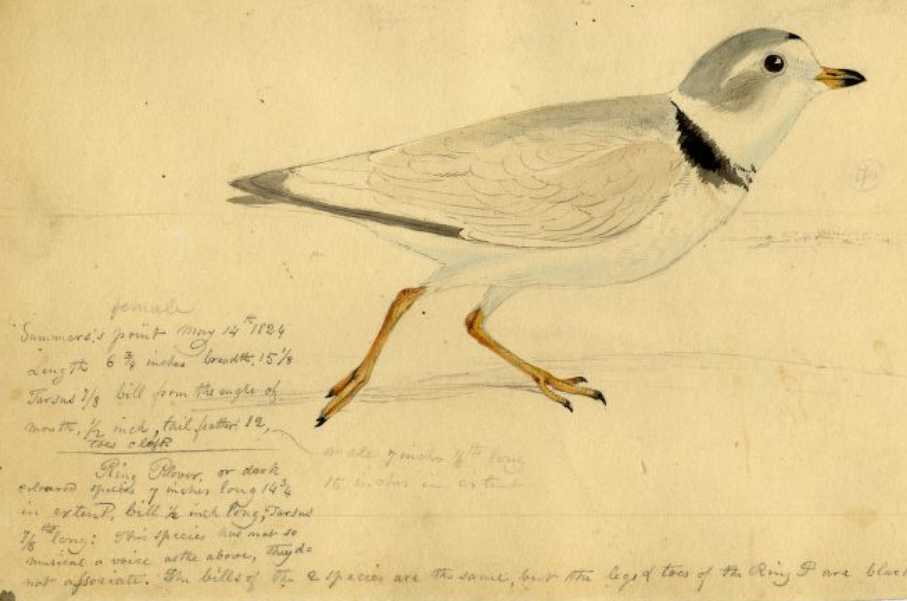
Bonaparte (1833: 75, American Ornithology vol. 4) wrote: “Although the never too much lamented Wilson gave, in his fifth volume, the present bird as a variety of which he intended figuring the type in a future part of his work, when he came to it in his seventh volume, he clearly and positively pointed out the difference in markings, habits, migrations, and voice, between the two which he then considered as distinct species … The only essential point he omitted was to impose a name on his species, which he undoubtedly would have done had he lived to publish himself the index to the water birds, as, in some instances, he supplied similar deficiencies for the land birds. Mr. [George] Ord has, however, filled this void by calling the bird C. melodus, which appropriate name we feel bound to adopt; and the more so, as Mr. Ord informs us that it would have been Wilson’s own choice.” A sketch by Titian R. Peale dated 14 May 1824, of a specimen he collected at Somer’s Point, New Jersey, includes a written comparison of the specimen to the “Ring Plover," noting their differences: "This species [Charadrius semipalmatus] has not so musical a voice as the above [C. melodus]. They do not associate. The bills of the 2 species are the same, but the legs & toes of the Ring Plover [C. semipalmatus] are black, the outer toe semipalmate." A finished watercolor of the same sketch, with scenery, and another watercolor painting where it is juxtaposed with Wilson’s Phalarope and Dunlin, are also extant (American Philosophical Society Library, Mss.B.P.31.15d).
Specimen Type:
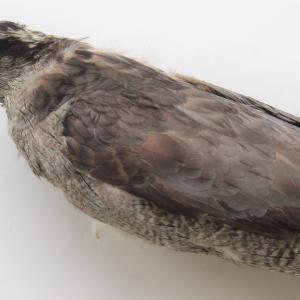
Dead/preserved
Current Common Name:
Piping Plover
Current Scientific Name
Charadriidae | Charadrius melodus