Object Status:
Unlocated
Accession Date:
By 1799
Primary Source Reference:
Charles Willson Peale, Lecture on Natural History 27. (ca. 1799). Academy of Natural Sciences of Drexel University Archives, coll. 40. / https://ansp.org/research/library/archives/0000-0099/coll0040/
Additional Source Text:
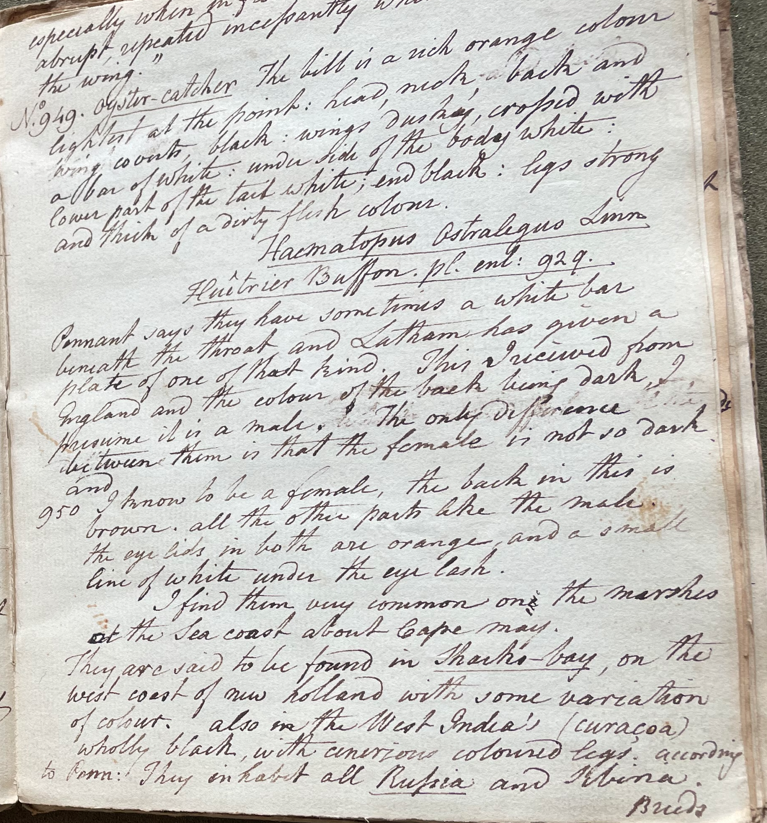
Charles Willson Peale (1741-1827) wrote, in his 27th Lecture (ca. 1799): "No. 949. Oyster-catcher. The bill is a rich orange colour, lightest at the point; head, neck, back and wing coverts, black; wings dusky, crossed with a bar of white; under sides of the body white; lower part of the tail white; end black; legs strong and thick of a dirty flesh colour. Haematopus ostralegus Linn. L'Huitrier Buffon pl. enl. 929. Pennant says they have sometimes a white bar beneath the throat and Latham has given a plate of one of that kind." (Academy of Natural Sciences of Drexel University Archives, coll. 40)
Peale continued: "This I received from England and the colour of the back being dark, I presume it is a male. The only difference between them is that the female is not so dark and No. 950 I know to be a female, the back in this is brown. All the other parts like the male. [Peale's "female" was actually an American Oystercatcher H. palliatus, now considered a different species.] The eye lids in both are orange and a small line of white under the eyelash. I find them very common on the marshes at the sea coast, about Cape May. They are said to be found in Shark's-bay, on the west coast of New Holland, with some variation of colour. Also in the West Indies (Curaçoa) wholly black, with cenerious coloured legs; according to Penn., they inhabit all Russia and Sibiria. Breeds on the great Artic flats, and extends to Kamtschatka." (ANSP Archives, coll. 40)
Peale wrote, in "A Walk Through the Philad[elphi]a Museum" (1805–1806): "Singular is the genus Haematopus or oister catcher their long compressed wedge form bill distinguishes it in a moment. They inhabit Europe, Assia and America. / Buffon says, "Those birds which disperse in our fields or retire under the shade of our forests, inhabit the most inchanting scenes, and the most peaceful retreats of Nature. / But such is not the lot of all the feathered race: some are confined to the solitary shores: to the naked beach, where the bellows dispute the possession of the land; to the rocks, on which the surges dash and roar; and to the insulated shelving banks which are beaten by the murmuring waves. In these desert stations, so formidable to every other being, a few birds, such as the oister catcher, obtain subsistance and security, and even enjoy pleasure and love. / It lives on sea worms, oisters, limpets, and other bivalves, which it gathers on the sand of the sea shore: it keeps constantly on the banks, which are left dry at low water, or on the little channels, where it follows the refluent tide; and never retires farther than the sandy hillocks which limit the beach. The darkest of this — is from England & the other from Cape May – called Sea-pie. Pied oister catcher (Haematopus ostralegus)." (Historical Society of Pennsylvania, coll. 0481)
Notes:
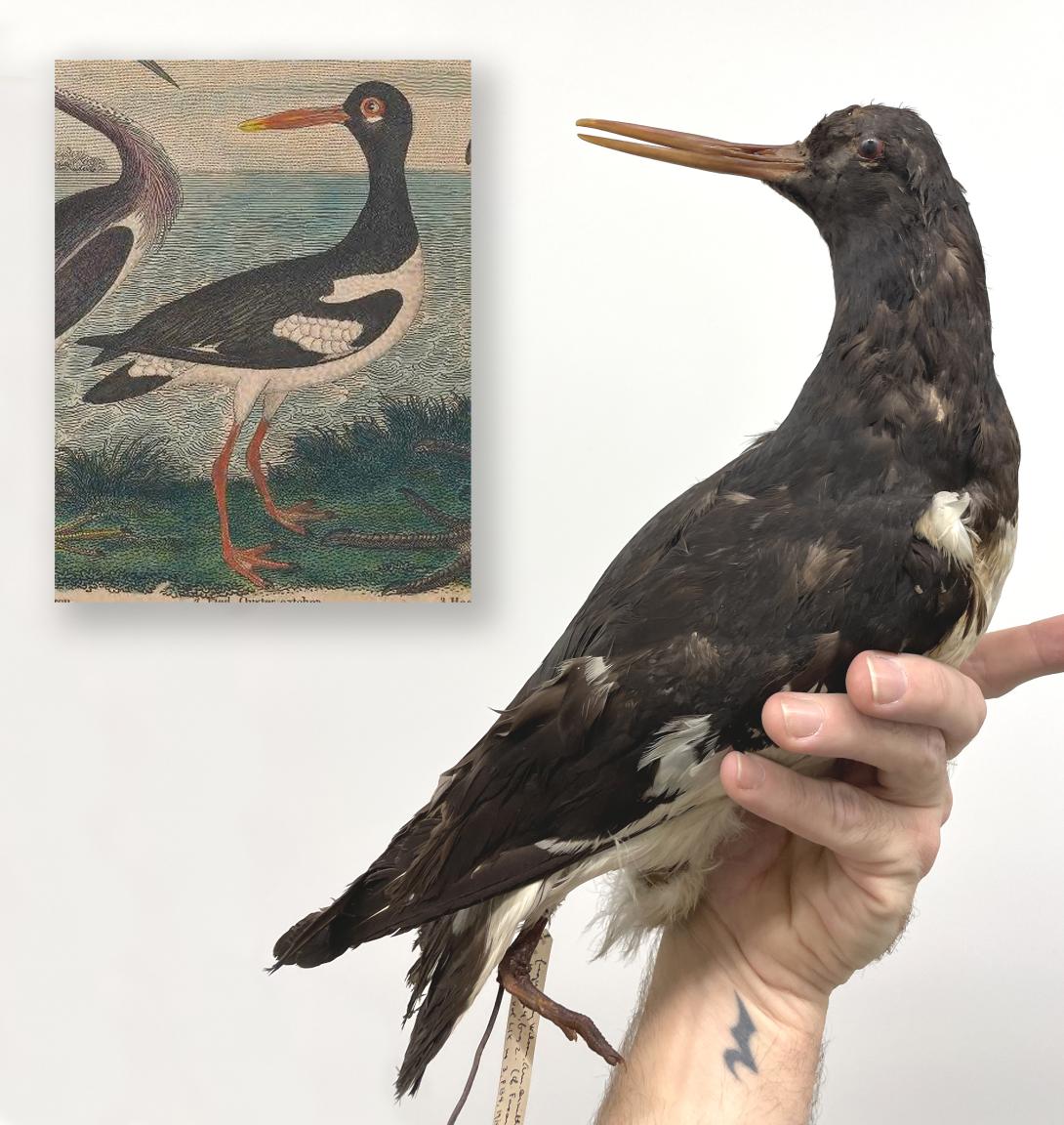
Peale had at least two oystercatcher specimens in his collection, which he incorrectly presumed to be a male and female of the same species. The "male" was a Pied Oystercatcher (H. ostralegus) and the "female" was an American Oystercatcher (H. palliatus). After Peale's Museum closed, a portion of Peale's bird collection was purchased in 1850 by Moses Kimball (1809–95), who displayed it at his "Boston Museum". An advertisement in the Boston Transcript, printed 1 October 1850, stated that Kimball had acquired "One Half of the celebrated Peale's Philadelphia Museum". The other half of Peale's birds had been sold to the circus promoter P. T. Barnum (1810–91) and would be subsequently destroyed in a fire at his "American Museum" in New York City in July 1865. When the Boston Museum closed, Kimball's Peale remnants passed temporarily to the Boston Society of Natural History, who disposed of them to Charles J. Maynard (1845-1929), a local taxidermist. The specimens were stored in a barn in Massachusetts for several years, then eventually were deposited at the Museum of Comparative Zoology (MCZ), Harvard University. By the time the collection was catalogued by Walter Faxon (1848-1920) at MCZ, in 1914, in virtually every case the original mounts and labels had been disassociated from the specimens, and an untold number were lost. Walter Faxon, "Relics of Peale's Museum," Bulletin of the Museum of Comparative Zoology, 59, no. 3 (July 1915): 134, referring to MCZ 67841 (shown here), a data-deficient specimen from the Boston Museum collection, wrote: "There is scant room for doubt that this is the individual figured by Wilson ... whatever the original of his description may have been. It is a European Oyster-Catcher, not palliatus. There is also a specimen of H. palliatus in the collection." This may be true, but the bill of MCZ 67841 is turned slightly upward, unlike the bird in Wilson's plate, and the pose is not identical. / https://www.biodiversitylibrary.org/page/6339801#page/184/mode/1up
Specimen Type:
Dead/preserved
Current Common Name:
Pied Oystercatcher
Current Scientific Name
Haematopodidae | Haematopus ostralegus
Repository:
Museum of Comparative Zoology, Harvard University (MCZ 67841)