Object Status:
Extant
Accession Date:
By 1799
Primary Source Reference:
Charles Willson Peale, Lecture on Natural History 36. (ca. 1799). Academy of Natural Sciences of Drexel University Archives, coll. 40. / https://ansp.org/research/library/archives/0000-0099/coll0040/
Additional Source Text:
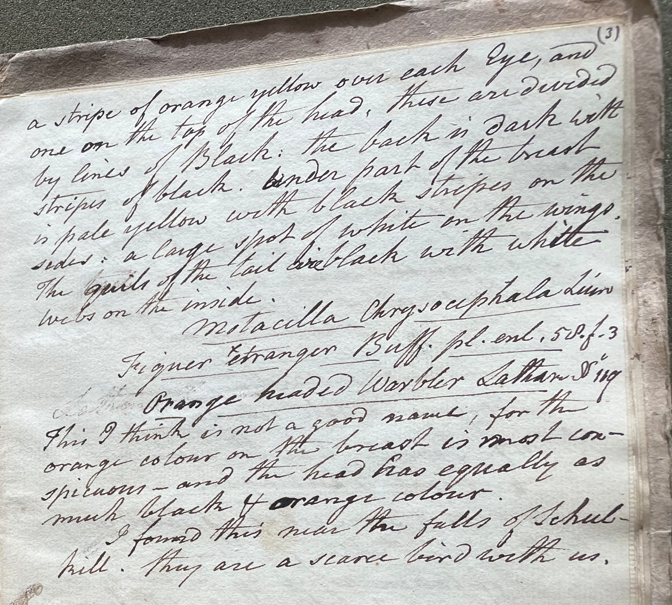
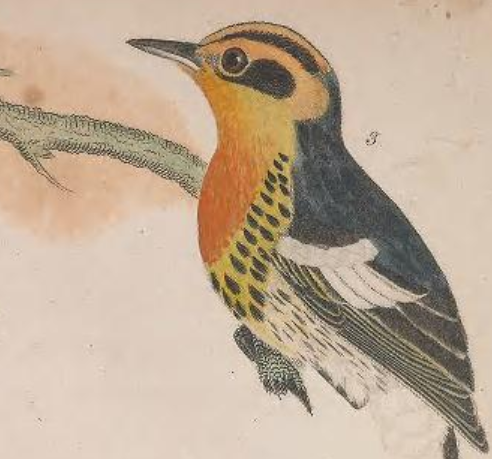
Charles Willson Peale (1741-1827) wrote, in his 36th Lecture (ca. 1799): "No. 1774. Orange breasted Warbler. this Bird has not been known to belong to this Country. Buffon has given a Plate which so much resembles it that I am persuaded his is the female, which he says is a new species found at Guiana, whence it was sent to the King's Cabinet, and he describes it as the Orange Fly-catcher." (Academy of Natural Sciences of Drexel University Archives, coll. 40)
Peale continued: "The breast is a brilliant orange colour; a stripe of orange yellow over each Eye, and one on the top of the head. these are divided by lines of Black; under part of the breast is pale yellow with black stripes on the sides; a large spot of white on the wings. The quils of the tail are black with white webs on the inside. Motacilla chrysocephala Linn. Figuier etranger Buff. pl. enl. 58. f. 3. Orange headed Warbler Latham No. 119. This I think is not a good name, for the orange colour on the breast is most conspicuous, and the head has equally as much black & orange colour. I found this near the falls of Schulkill [i.e., East Falls neighborhood of modern Philadelphia]. they are a scarce bird with us." (ANSP Archives, coll. 40)
Alexander Wilson (1766-1813) described this species under the name "Blackburnian Warbler / Sylvia blackburnia" in American Ornithology vol. 3 (Pl. 23), where "Peale's Museum, No. 7060" was cited (Wilson 1811: 64). / https://www.biodiversitylibrary.org/item/175516#page/78/mode/1up (text) / https://www.biodiversitylibrary.org/item/175516#page/72/mode/1up (plate)
Specimen Type:
Dead/preserved
Current Common Name:
Blackburnian Warbler
Current Scientific Name
Parulidae | Setophaga fusca