Object Status:
Extant
Accession Date:
By 30 April 1797
Primary Source Reference:
Charles Willson Peale, letter to Étienne Geoffroy Saint-Hilaire (1772-1844) dated 30 April 1797; Selected Papers, 2, part 1: 198.
Additional Source Text:
Charles Willson Peale (1741-1827) sent a "large white owl" to Étienne Geoffrey Saint-Hilaire (1772-1844) at the Paris Museum on 30 April 1797, with a note that read: "No. 3. a large white owl, is a rare bird I have obtained not seldom found here. I had no good Eyes or I should have put them to it—The colour of which is a bright yellow" (Miller 1988: 199, Selected Papers, Vol. 2, part 1, Yale University Press).
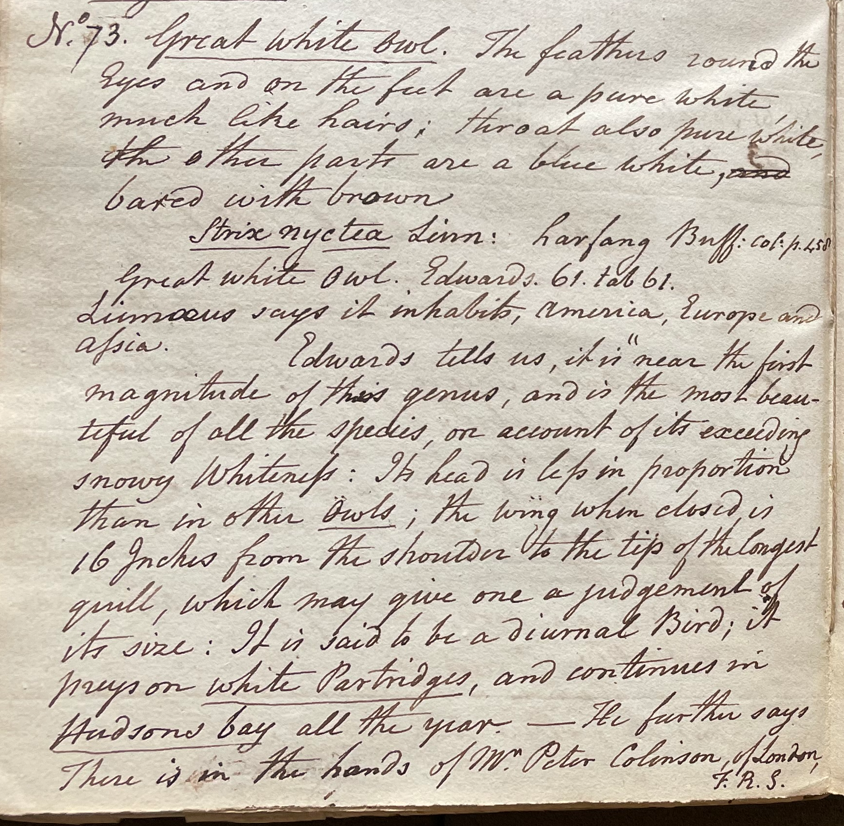
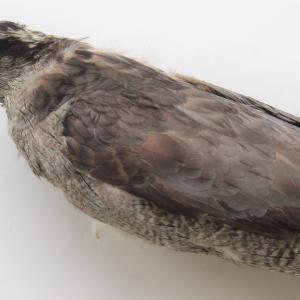
In his 14th Lecture, Peale wrote: "No. 73. Great White Owl. The feathers round the eyes and on the feet are a pure white much like hairs; throat also pure white; the other parts are a blue white, barred with brown. Strix nyctea Linn. harfang Buff. col. p. 458. Great White Owl, Edwards. 61. tab. 61. Linnaeus says it inhabits America, Europe and Assia. Edwards tells us, 'it is "near the first magnitude of this genus, and is the most beautiful of all the species, on account of its exceeding snowy whiteness. Its head is less in proportion than in other Owls; the wing when closed is 16 Inches from the shoulder to the top of the longest quill, which may give one a judgement of its size. It is said to be a diurnal Bird; it preys on white partridges and continues in Hudson's Bay all the year'." (Academy of Natural Sciences of Drexel University Archives, coll. 40)
Peale continued: "He further says There is in the hands of Mr. Peter Collinson, F.R.S. [1694-1768], of London, an oil painting of the size of life, done in Pennsylvania by order [of William] Penn Esqr., from one of these birds taken alive, and keept [sic] some time. The reason why Mr. Penn caused this bird to be drawn, was, because of its great rarity, not having been ever observed before in Pennsylvania; so that I suppose it inhabits only the most northern parts of America. I cannot find any account has been yet given in print of this curious bird. No doubt it is a rare bird with us, yet in the winter of 1792, I had 3 sent to me, all found in the vicinity of Philada., and the year before, one was taken near Georgetown, in Maryland, on the Virginia shore, of the same size and delicacy of whiteness, but with perfect round spots on all the body feathers." (ANSP Archives, coll. 40)
Peale continued: "These [specimens] are barred. It was sent to me in the stage, the direction being rubbed off the box that contained it – prevented me from finding it, until it had become too putrid to be mounted. Since finding it so rare a bird, I much regret that I did not preserve some part of it. / No. 74. It is a variety of the same bird of the preceeding number, but in a white dress. In Pennant's Arctic Zoology I find this account … [long verbatim quote]. Thus, [contra] Pennant, I kept one alive for many months, and do not remember ever to have heard a hidious cry from it." (ANSP Archives, coll. 40)
Peale wrote, in "A Walk Through the Philad[elphi]a Museum" (1805–1806): "In the 2d. division; those without horns, among them the most remarkable is the great White owl (nyctea). It differs from others by its seeing & taking its prey in daylight. The visit us occasionally, perhaps when the season is sever towards Hudsons bay." (Historical Society of Pennsylvania, coll. 0481)
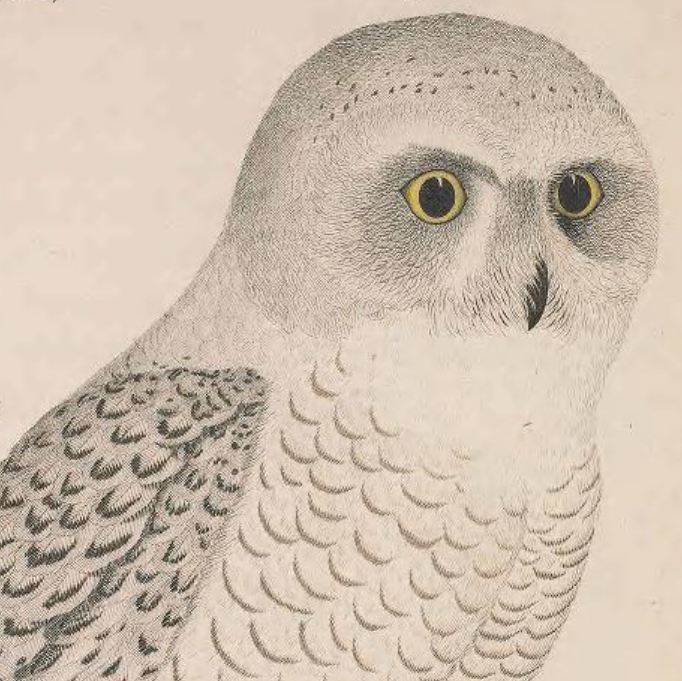
Alexander Wilson (1766-1813) described this species under the name "Snow Owl / Strix nyctea" in American Ornithology vol. 4 (Pl. 32), where "Peale's Museum, No. 458" was cited (Wilson (1811: 53). Wilson mentioned that "a person living on the eastern shore of Maryland shot one of these birds a few months ago, a female, and having stuffed the skin brought it to Philadelphia, to Mr. Peale in expectation no doubt of a great reward." / https://www.biodiversitylibrary.org/item/175531#page/67/mode/1up (text) / https://www.biodiversitylibrary.org/item/175531#page/66/mode/1up (plate)
An unmounted male specimen of "Strix nyctea (Snowy Owl)" was listed in "A Catalogue of Duplicate Specimens...", May 1822. [unpublished] American Philosophical Society Library (Mss.B.P31).
Specimen Type:
Dead/preserved
Current Common Name:
Snowy Owl
Current Scientific Name
Strigidae | Bubo scandiacus