Object Status:
Unlocated
Accession Date:
By 1799
Primary Source Reference:
Charles Willson Peale, Lecture on Natural History 34. (ca. 1799). Academy of Natural Sciences of Drexel University Archives, coll. 40. / https://ansp.org/research/library/archives/0000-0099/coll0040/
Additional Source Text:
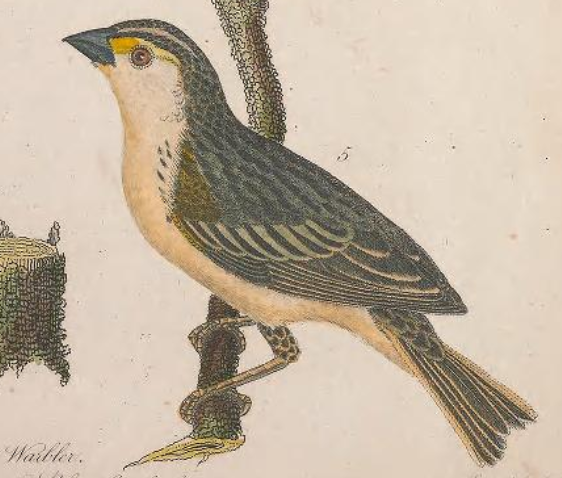
Charles Willson Peale (1741-1827) wrote, in his 34th Lecture (ca. 1799): "No. 1610. Green Shouldered Sparrow. It is a small bird. It may be distinguished by two good marks, besides the yellow green on the shoulders, it has a yellow line from base of the bill on each side extending to the upper part of the Eyes; also a bright yellow edge to the wings. the top of the head dark with a white line in the center; this assimilates it considerably to the white throat sparrow No. 1591; back, wings & tail brown russet & grey and the breast & underparts sallow white. No. 1611. Female, much like the male." (Academy of Natural Sciences of Drexel University Archives, coll. 40)
Peale wrote, in "A Walk Through the Philad[elphi]a Museum" (1805–1806): "…green shoulder Sparrow – are found in the vicinity of Philadelphia. very few of our Sparrows have been described by Naturalists." (Historical Society of Pennsylvania, coll. 0481)
Alexander Wilson (1766-1813) described this species under the name "Yellow-winged Sparrow / Fringilla passerina" in American Ornithology vol. 3 (Pl. 24), where "Peale's Museum, No. 6585" was cited (Wilson 1811: 76) / https://www.biodiversitylibrary.org/item/175516#page/92/mode/1up (text) / https://www.biodiversitylibrary.org/item/175516#page/83/mode/1up (plate)
Notes:
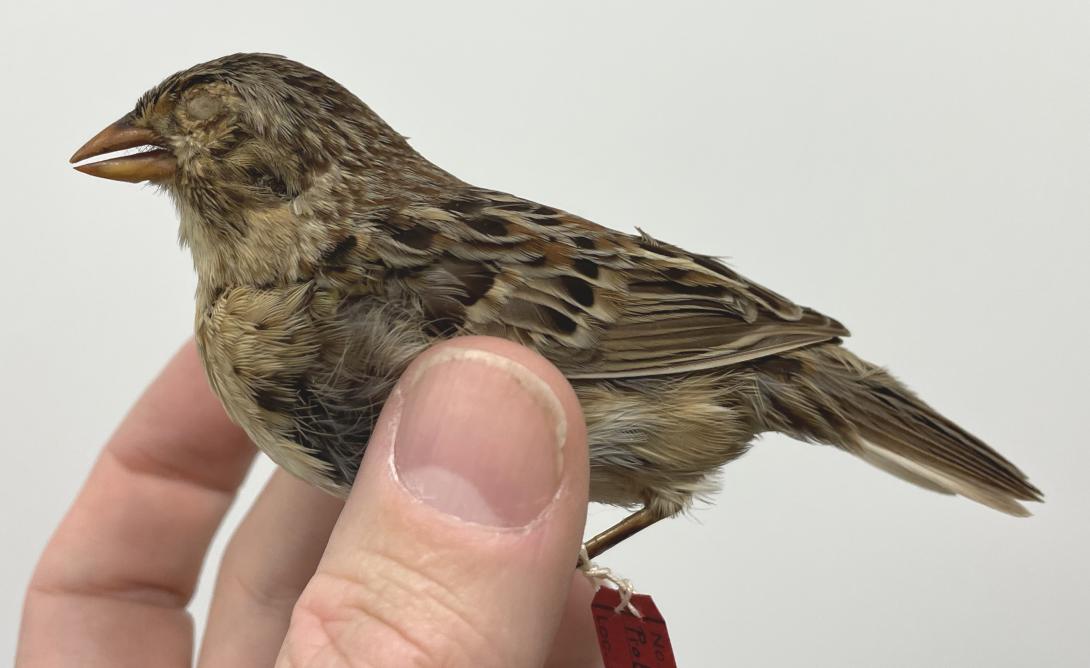
After Peale's Museum closed, a portion of Peale's bird collection was purchased in 1850 by Moses Kimball (1809–95), who displayed it at his "Boston Museum". An advertisement in the Boston Transcript, printed 1 October 1850, stated that Kimball had acquired "One Half of the celebrated Peale's Philadelphia Museum". The other half of Peale's birds had been sold to the circus promoter P. T. Barnum (1810–91) and would be subsequently destroyed in a fire at his "American Museum" in New York City in July 1865. When the Boston Museum closed, Kimball's Peale remnants passed temporarily to the Boston Society of Natural History, who disposed of them to Charles J. Maynard (1845-1929), a local taxidermist. The specimens were stored in a barn in Massachusetts for several years, then eventually were deposited at the Museum of Comparative Zoology (MCZ), Harvard University. By the time the collection was catalogued by Walter Faxon (1848-1920) at MCZ, in 1914, in virtually every case the original mounts and labels had been disassociated from the specimens, and an untold number were lost. Walter Faxon, "Relics of Peale's Museum," Bulletin of the Museum of Comparative Zoology, 59, no. 3 (July 1915): 137, speculated that MCZ 67857 (shown here), a data-deficient specimen from the Boston Museum collection, was "Very probably Wilson's type." This may be true, but Peale had specimens of this species in his collection by 1799, and he had little space (or interest) to display duplicates. / https://www.biodiversitylibrary.org/page/6339801#page/187/mode/1up Wilson (1810: viii, American Ornithology, vol. 2) also stated that "no drawings have been, or will be made for this work, from any stuffed subjects, where living specimens of the same can be procured; yet the former serve a very important purpose; they enable the author to ascertain the real existence and residence of such subjects". / https://www.biodiversitylibrary.org/item/175511#page/14/mode/1up Wilson deposited many specimens at Peale's Museum, after completing his drawings, but the combined evidence from American Ornithology and the Peale Museum Accessions Book (Historical Society of Pennsylvania, coll. 0481) suggests that he deposited probably fewer than 100 skins total (and possibly as few as 40-50), whereas many authors have assumed that all the "Peale numbers" cited in Wilson's work were those of his own specimens (e.g., "he contributed 279 specimens to the collection", Edward H. Burtt, Jr., and William E. Davis, Jr., 2013, Alexander Wilson: The Scot Who Founded American Ornithology, Belknap Press, p. 310). This assumption appears to be based on a misunderstanding — Wilson was citing the numbers to give credit to Peale, to acknowledge his contributions, not to stake a claim to his own specimen deposits. To the editor's (MRH) knowledge, there is no evidence that Wilson deposited a Grasshopper Sparrow at Peale's Museum. Despite this uncertainty, the MCZ online database lists MCZ 67857 as the "Holotype of Fringilla passerina" (a junior synonum of the older name Ammodramus savannarum (Gmelin, 1789), which holds taxonomic priority) and the specimen was included in a recently funded grant proposal aimed at "Preserving the genomes of the type specimens in the MCZ (CSBR)" (National Science Foundation, NSF Collections in Support of Biological Research: Award #1946857). / https://mczbase.mcz.harvard.edu/guid/MCZ:Orn:67857
Specimen Type:
Dead/preserved
Current Common Name:
Grasshopper Sparrow
Current Scientific Name
Passerellidae | Ammodramus savannarum
Repository:
Museum of Comparative Zoology, Harvard University (MCZ 67857)