Object Status:
Extant
Accession Date:
By 1799
Primary Source Reference:
Charles Willson Peale, Lecture on Natural History 36. (ca. 1799). Academy of Natural Sciences of Drexel University Archives, coll. 40. / https://ansp.org/research/library/archives/0000-0099/coll0040/
Additional Source Text:
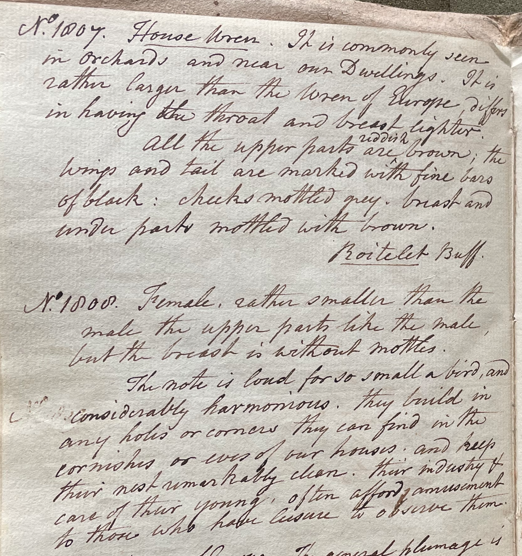
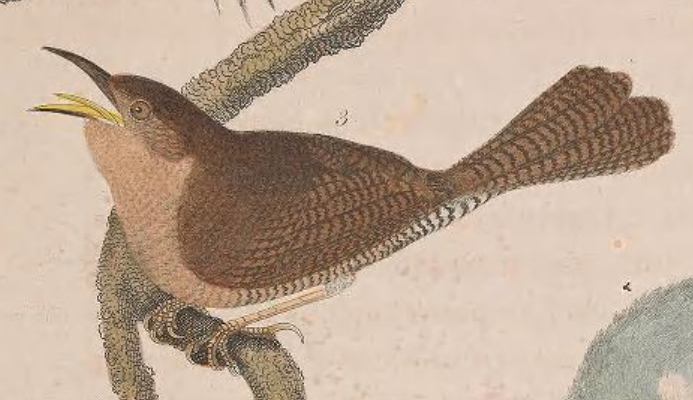
Charles Willson Peale (1741-1827) wrote, in his 36th Lecture (ca. 1799): "No. 1807. House Wren. It is commonly seen in orchards and near our Dwellings. It is rather larger than the wren of Europe, differs in having the throat and breast lighter. All the upper parts are reddish brown; the wings and tail are marked with fine bars of black; cheeks mottled grey; breast and under parts mottled with brown. Roitelet Buff. No. 1808. Female, rather smaller than the male; the upper parts like the male, but the rbeast is without mottles. The note is loud for so small a bird, and considerably harmonious. they build in any holes or corniers they can find in the cornishes or eves of our houses, and keep their nest remarkably clean. their industry & care of their young, often affords amusement to those who have leisure to observe them." (Academy of Natural Sciences of Drexel University Archives, coll. 40)
Alexander Wilson (1766-1813) described this species under the name "House Wren", without giving a Linnaean binomial name, in American Ornithology vol. 1 (Pl. 8), where "Peale's Museum No. 7283" was cited (Wilson 1808: 129). / https://www.biodiversitylibrary.org/item/175530#page/157/mode/1up (text) / https://www.biodiversitylibrary.org/item/175530#page/149/mode/1up (plate)
Specimen Type:
Dead/preserved
Current Common Name:
House Wren
Current Scientific Name
Troglodytidae | Troglodytes aedon