Object Status:
Extant
Accession Date:
By 1812
Primary Source Reference:
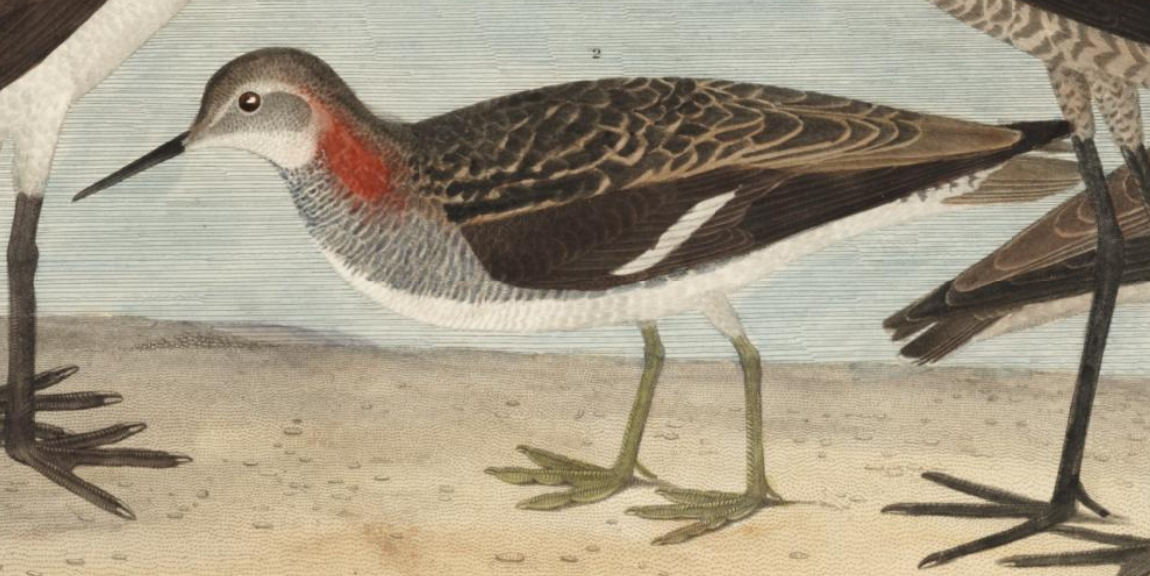
Alexander Wilson (1814). American ornithology, or, The natural history of the birds of the United States: illustrated with plates engraved and colored from original drawings taken from nature. Volume 9, Plate 73. Philadelphia: Bradford and Inskeep, Robert Carr / https://www.biodiversitylibrary.org/item/175518#page/81/mode/1up (text) / https://www.biodiversitylibrary.org/item/175518#page/8/mode/1up (plate)
Additional Source Text:
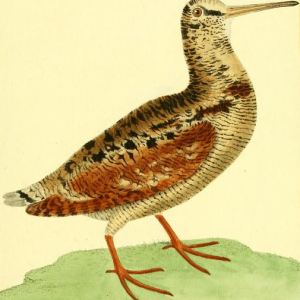
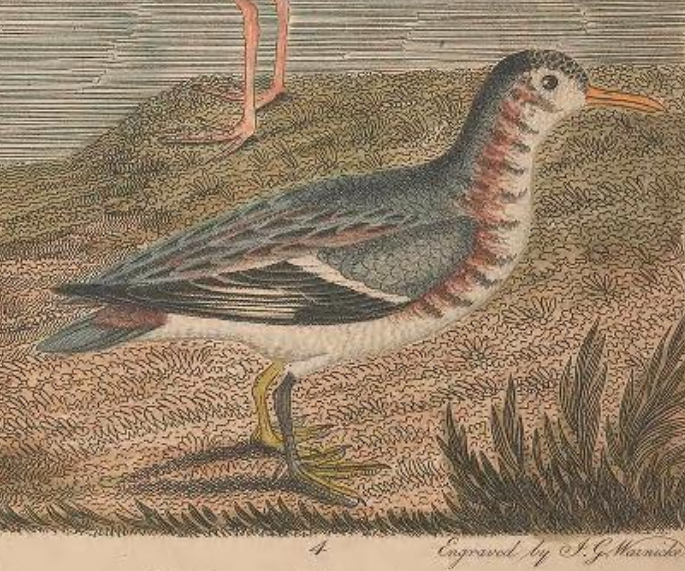
This species appeared under the name "Red Phalarope / Phalaropus hyperborea" in American Ornithology vol. 9 (Pl. 73), in a posthumous account that was not written by Alexander Wilson (1766-1813), but George Ord (1781–1866), the editor of the volume.
Ord cited "Peale Museum, No. 4088" and wrote "…three were seen in a pond below Philadelphia, in the latter part of May, 1812 [i.e., more than one year before Wilson's death], one of which was shot, and presented to the editor [Ord], who transferred it to Mr. Peale. In consequence of its being in a high state of putridity when recieved, it was preserved with considerable difficulty, and the sex could not be ascertained. Our figure and description were from this specimen. The person who shot this bird [apparently not Wilson] had never seen one of the species before, and was particularly struck with its singular manners. He described it sitting on the water, dipping in its bill very often, as if feeding, and turning frequently round." (Ord in Wilson 1814: 76). / https://www.biodiversitylibrary.org/item/175518#page/82/mode/1up
Wilson evidently saw that specimen, because he wrote to Ord from "Boston, [on] 13 October 1812": "From this place my journey led me over a rugged, mountainous country, to Lake Champlain, along which I coasted as far as Burlington in Vermont. Here I found the little Coot-footed Tringa or Phalarope that you sent to Mr. Peale; a new and elegantly marked Hawk; and observed some Black Ducks" (Clark Hunter, 1983, Life and Letters of Alexander Wilson, p. 333).
Notes:
Around 1823-24, when Ord was preparing to publish a second edition of American Ornithology, of which the 9th volume (containing the phalaropes) would bear a new title, Supplement to the American ornithology of Alexander Wilson (1825), he took a copy of the original pressing (Wilson 1814) and marked it up with ink, making edits to the original copy and adding footnotes. This copy, from which many pages have been torn out, is now preserved in the Academy of Natural Sciences of Drexel University (ANSP) Archives (coll. 280); to the Editor's (MRH) knowledge, it has not been discussed in literature heretofore. This was evidently Ord's first editorial pass, because not every edit made it into the final version (i.e., the text of the Supplement..., 1825). To the original 1814 account of "Red Phalarope / Phalaropus hyperborea" (p. 75), Ord first added "-us" so that the scientific name would read "Phalaropus hyberboreus". Then, he changed his mind and replaced it with "Lobatus". He also changed the name "Red Phalarope" to "Gray Phalarope" and added a footnote, which read: "Named in the plate Red Phalarope". (ANSP Archives, coll. 280) The English name alteration (i.e., red to gray) and its explanatory footnote were included in the published Supplement (1825: 237), but the scientific name that was eventually published was "Phalaropus fulicarius", and much of the account was completely rewritten. Ord also added new details about a specimen collected by "my friend, Mr. Le Sueur" [Charles Alexandre Lesueur, 1778-1846] in Boston in 1816, and another specimen that he collected himself in Florida in 1818. / https://www.biodiversitylibrary.org/item/227703#page/243/mode/1up Ord's 1818 specimen is unlikely to have been deposited in Peale's Museum, because it was collected on an expedition sponsored by the fledgling Academy of Natural Sciences of Philadelphia, founded in 1812, which was then building the nucleus of its own collection. For more, see Thomas Peter Bennett, 2002, "The 1817 Florida Expedition of The Academy of Natural Sciences", Proceedings of the Academy of Natural Sciences of Philadelphia 152: 1-21. / https://doi.org/10.1635/0097-3157(2002)152[0001:HFTFEO]2.0.CO;2
Specimen Type:
Dead/preserved
Current Common Name:
Red-necked Phalarope
Current Scientific Name
Scolopacidae | Phalaropus lobatus