Object Status:
Extant
Accession Date:
By 1799
Primary Source Reference:
Charles Willson Peale, Lecture on Natural History 23. (ca. 1799). Academy of Natural Sciences of Drexel University Archives, coll. 40. / https://ansp.org/research/library/archives/0000-0099/coll0040/
Additional Source Text:
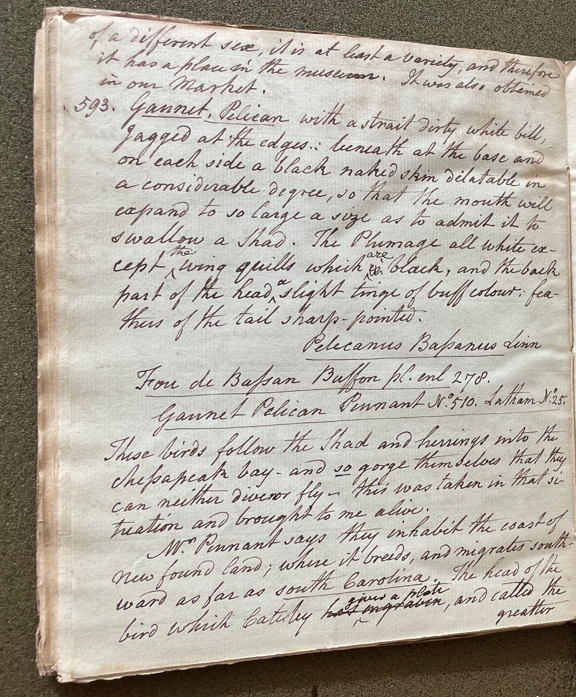
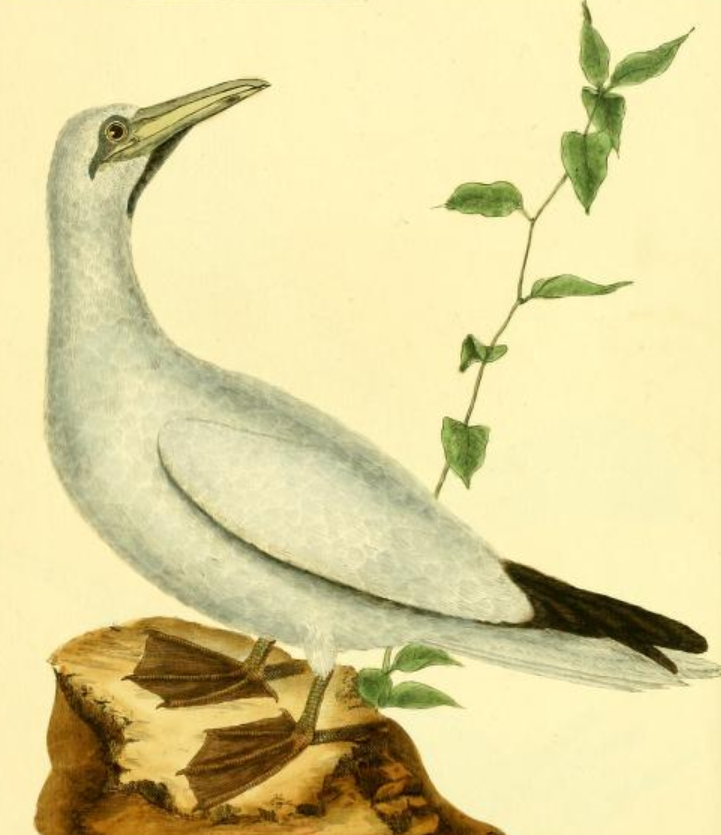
Charles Willson Peale (1741-1827) wrote, in his 23rd Lecture (ca. 1799): "593. Gannet, Pelican with a strait dirty white bill, jagged at the edges; beneath at the base and on each side a black naked skin dilatable in a considerable degree, so that the mouth will expand to so large a size as to admit it to swallow a Shad. The Plumage all white except on the wing quills which are black, and the back part of the head, a slight tinge of buff colour; feathers of the tail sharp-pointed. Pelecanus bassanus Linn. Fou de Bassan Buffon pl. enl. 278. Gannet L'Pelican Pennant No. 510. Latham No. 25. These birds follow the Shad and herrings into the Chessapeak bay, and so gorge themselves that they can neither dive nor fly. this [specimen] was taken in that situation and brought to me alive. Mr. Pennant says they inhabit the coast of New found land; where it breeds, and migrates southward as far as south Carolina." (Academy of Natural Sciences of Drexel University Archives, coll. 40)
Peale continued: "The head of the bird which Catesby has engraven gives a plate, and called the greater booby [Catesby] i. t.86 is of one in its young state. At that period it is deep ash-coloured, spotted with white. In Europe it is common on the coast of Norway and Iceland; but as it never voluntarily flies over land, is not seen in the Baltic. Wanders for food as far as the coast of Lisbon, and Gibraltar, where it has been seen in December, plunging for Sardinae. Straggles as high as Greenland. In northern Assia, it has been once seen by Stellar off Bering's isle; but has been frequently met with in the southern hemisphere, in the Pacific ocean; particularly, in numbers about New Zealand and New Holland. Captain Cook also saw them in his passage from England to the Cape of good hope, and remoter from land than they had been seen else where. Among those observed in the south sea, is the variety called Sula, with a few black feathers in the tail and among the secondaries." (ANSP Archives, coll. 40)
Peale wrote, in "A Walk Through the Philad[elphi]a Museum" (1805–1806): "[The frigatebird] is called voracious, yet the Gannet (P. Bassanus) certainly exceed it in Glutony for they will swallow so many Herrengs & shad that they can neither fly or dive, and in that situation this was taken alive in the Chessapeak where it had followed the fish into that Bay." (Historical Society of Pennsylvania, coll. 0481)
Specimen Type:
Live (later taxidermied)
Current Common Name:
Northern Gannet
Current Scientific Name
Sulidae | Morus bassanus