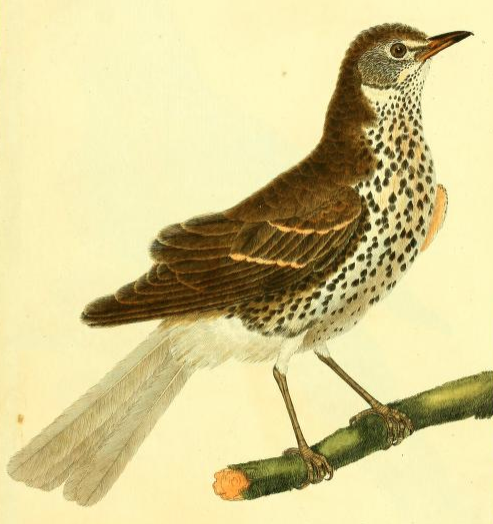
Object Status:
Extant
Accession Date:
By 1799
Primary Source Reference:
Charles Willson Peale, Lecture on Natural History 31. (ca. 1799). Academy of Natural Sciences of Drexel University Archives, coll. 40. / https://ansp.org/research/library/archives/0000-0099/coll0040/
Additional Source Text:
Charles Willson Peale (1741-1827) wrote, in his 31st Lecture (ca. 1799): "No. 1286. Trostle Thrush, which Mr. Pennant says is the finest of singing birds in England, not only for the sweetness and variety of its notes, but for the long continuence of its harmony; for it obliges them with its song for 3 parts of the year. like the Missel bird [i.e., Missel Thrush, Turdus viscivorus], it delivers its music from the top of some high tree, sweetly beguiling the footsteps of the listening traveller, but to form its nest descends to some low bush or thicket; the nest is made of earth, moss and straws, and the inside is curiously plastered with clay. It lays 5 or 6 eggs, of a pale blueish green, with dusky spots. The weight of this species is 3 ozs.; the length 9 Inches; the breadth 13 ½. In colors it so nearly resembles the missel Thrush, that no other remark need be added, but that it is less, and that the inner coverts of the wings are yellow. Turdus musicus Linn. La Grive Buff. pl. enl. 406." (Academy of Natural Sciences of Drexel University Archives, coll. 40)
Peale continued: "No. 1287. Female differs from the male, by having the spots less distinct. It is meet with in many parts of Russia, especially where Junipers grow; most frequently about the river Kama, but not in Sibiria [Peale inserted a note here indicating that he sourced this information from Pennant]. This bird is thought a great-delicacy in Europe; especially in autumn when they feed on Berries & grasses." (ANSP Archives, coll. 40)
Peale wrote, in "A Walk Through the Philad[elphi]a Museum" (1805–1806): "…Trostle Thrush (T. musicus) which W. Pennant says is the finest of singing birds in England, not only for the sweetness and variety of its notes, but for the long continuance of its harmony; for it obliges them with its song for 3 parts of the year." (Historical Society of Pennsylvania, coll. 0481)
A mounted specimen of "Turdus musicus (Song Thrush)" from Europe was listed in "A Catalogue of Duplicate Specimens...", May 1822. [unpublished] American Philosophical Society Library (Mss.B.P31).
Specimen Type:
Dead/preserved
Current Common Name:
Song Thrush
Current Scientific Name
Turdidae | Turdus philomelos